Water Distribution-Level 1 Operator Certification Training Course, in Camp Verde, Arizona, March 17-28, 2025, (Event ID #25003-blended), Region 9 Priority

Water Distribution-Level 1 Operator Certification Training Course, in Camp Verde, Arizona, March 17-28, 2025, (Event ID #25003-blended), Region 9 Priority

Part 1 Meets: Monday through Friday (on-line)
Dates: March 17-21, 2025
Time: 8:00 a.m. – 12:00 p.m. (Pacific Daylight Time)

Part 2 Meets: Monday through Friday (in-person)
Dates: March 24-28, 2025
Time: 8:00 a.m. – 5:00 p.m. (Local Time)
Location: Camp Verde, Arizona

Click here: Brochure & Registration Forms
Click here: Electronic Registration
Click here: Application for Water Certification
Click here: Need to Know for Exam 1: Federal Regulations Exam Module for Water Distribution
Click here: Need to Know for Exam 2: Water Treatment Operator Class I

Get Adobe Acrobat Reader

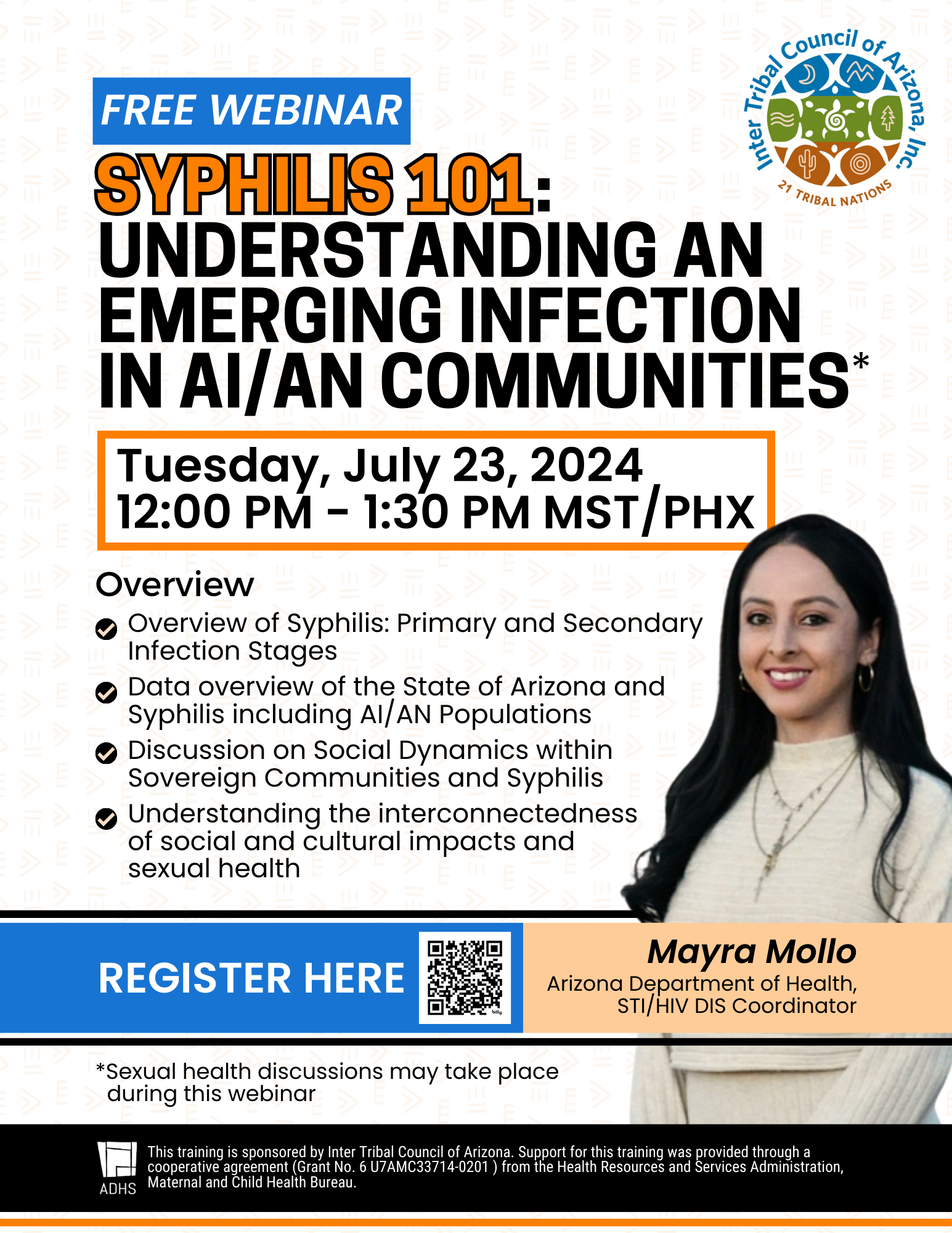
Syphilis 101: Understanding an Emerging Infection in AI/AN Communities

July 23, 2024 

12:00-1:30pm MST/PHX

Topic: Syphilis 101: Understanding an Emerging Infection in AI/AN Communities

Presenter: Mayra Mollo, ADHS, STI/HIV DIS Coordinator

Nurturing Connections

Nurturing Connections: The Social-Ecological Model, ACES and Maternal Health

July 17, 2024 and July 31, 2024 

12:00-1:30pm

Topic: Nurturing Connections: The Social-Ecological Model, ACES and Maternal Health

Presenters:
Stephanie Noriega, University of Arizona
Lakisa Muhammad, AZ Birthworkers of Color

Nurturing Connections

Arizona Department of Health Services: Doula Licensing

Laws 2021, Ch. 282 (Senate Bill 1181), created a voluntary licensing program for doulas within the Arizona Department of Health Services. A.R.S. § 36-766(3) states, a “doula” is “… a trained nonmedical professional who may provide continuous physical, emotional and informational support to families before, during and after childbirth for a period of one year after birth or in the case of loss and who may serve as a liaison between the birth parents and medical and social services staff to improve the quality of medical, social, and behavioral outcomes.”- ADHS

Resources & Information: 

Maternal Mortality and Severe Maternal Morbidity Data presented by Arizona Department of Health Services

Topic: Maternal Mortality and Severe Maternal Morbidity Data presented by Arizona Department of Health Services
Date: June 30, 2023
Time: 10:00AM-11:00AM MST
Presenter: Glenda M. Ramirez, MPH, and Aubri Perez
Link to Recording

Links to Resources:
Presentation Slides


The Importance of Postpartum Care

Topic: The Importance of Postpartum Care
Presenter: Jacqueline Badine, RDN
Link to Recording

The Importance of Postpartum Care Presentation

Nutrition and Pregnancy

April 27, 2023

Topic: Nutrition and Pregnancy
Presenter: Jacqueline Badine, RDN
Link to Recording

Links to Resources:
Nutrition and Pregnancy Presentation
Healthy eating during pregnancy
Healthy eating tips while pregnant
My plate
Cooking temperatures

Breastfeeding Training for Healthcare Providers- Together for the Duration

The Together for the Duration is a program developed by the Arizona Department of Health Services, AZ Health Zone, and the Arizona WIC Program to support health care professionals in their lactation education and build stronger community partnerships while working with maternal and infant populations. The Together for the Duration series contains 15 online learning courses. Each course is 60 minutes long, including the review of external resources and completion of all items within the course.

More information is available here.

Standardized Prenatal & Postpartum Care at Whiteriver Indian Hospital Birthing Center

March 29, 2023

Topic: Standardized Prenatal & Postpartum Care at Whiteriver Indian Hospital Birthing Center
Presenter: Laura Close, DNP, FNP-BC

Link to Recording

Link to Resource:
Presentation Slides

Navigating Maternal Health Care

 March 22, 2023

Topic: Navigating Maternal Health Care
Presenter: Nicolle L. Gonzales, BSN, RN, MSN, CNM

Link to Recording

Links to Resources:
Presentation Slides
Road Map through Pregnancy Care

The Power of Prenatal Care During Pregnancy

February 27, 2023

Topic: The Power of Prenatal Care during Pregnancy
Presenter: Jacqueline Badine, RDN

Link to Recording

Links to Resources:
Presentation Slide

Reproductive Grief Care: Sensitivity to Pregnancy Loss

February 24, 2023

Topic: Reproductive Grief Care: Sensitivity to Pregnancy Loss
Presenter: Sara West, MSHS-PH
Link to Recording

Links to Resources:
Presentation Slides
Best Practices
Misconceptions about Miscarriages
I Care- What to do if someone shares their story
Patient Information Sheet- Grief and Loss after Miscarriage
Patient Information Sheet- Grief and Loss after Abortion
abortionchangesyou.com

ACES and Trauma Informed Perinatal Care

January 10, 2023

Topic: Adverse Childhood Experiences (ACEs) and Trauma Informed Perinatal Care
Presenter: Valerie M. Kading, DNP, MBA, MSN, PMHNP-BC
Link to Recording

Links to Resources:
ACE Questionnaire
Preventing ACEs
ACEs in AI/AN Population Article
ACEs Aware
ACEs Resource Basket

Voting During a Pandemic Requires Coordinated Effort, Planning

BY MARIA DADGAR NOVEMBER 02, 2020

OPINION. In the state of Arizona, American Indian people have fought a long political battle for the right to vote. It wasn’t until 1924 that the Indian Citizenship Act was passed and even though American Indians became citizens, they were still not eligible voters in Arizona. It took numerous lawsuits by American Indian citizens, Tribal leaders and Tribal Nations in Arizona before voting rights were won in July of 1948. Though the victory in 1948 was a milestone, American Indians are still facing obstacles and barriers getting to the polls and casting their vote.

While history has shown that American Indians in Arizona have experienced levels of disenfranchisement during elections, our tribal communities have also been disproportionately impacted by the COVID-19 pandemic. Tribes in Arizona have been significantly impacted by the pandemic and it will take coordinated efforts on many levels to facilitate Native people to vote during the 2020 election. These efforts must be led by tribal and state governments as well as each tribal citizen to ensure everyone – from young people to elders – have an opportunity to exercise their right to vote. The Inter Tribal Council of Arizona (ITCA), and Tribal leaders across the state agree that the Native vote is critical during this election.

Maria Dadgar
Maria Dadgar, Executive Director
of the Inter Tribal Council of Arizona. (ITCA)

The COVID-19 pandemic has significantly changed our lives from the way we interact with our families and coworkers to how our Tribal Nations govern and support their citizens. I’m incredibly proud of the ways our Tribal leaders in Arizona have responded to the COVID-19 pandemic and worked to immediately mobilize resources to protect Tribal members, families, elders and employees. We have seen how Tribes in Arizona have worked collectively to respond to the pandemic across the state.

The pandemic brings an added challenge to voting in this election, but we are certain that Tribes are doing all they can to facilitate Tribal members’ participation in the upcoming election. We understand that Tribal governments are taking extra precautions and collaborating with public health experts in planning a safe experience for voting absentee by mail, early in-person voting or in-person on Election Day. During a public health emergency, we need to be guided by health experts and data.

According to the U.S. Census Bureau, in 2018 there were more than 309,000 American Indian and Alaska Native eligible voters in Arizona. That is 6% of the state’s population – a percentage that can certainly make a difference in any election. Yet, the turnout among our demographic is one to 10 percentage points lower than the rate of others. Even though we’re facing this new challenge of the COVID-19 pandemic, we must work together to increase Native voter turnout and see ourselves as advocates of change and protectors of Tribal sovereignty.

Despite all of the obstacles, we all still need to vote. In order to vote during the pandemic, make a plan to vote by mail or in-person. Mail in your ballot right away, especially if you live in remote areas of the state. In-person voting is an option – either early or on Election Day – make sure you practice all Tribal and state public health orders. Wear a mask, stay six feet apart and wash your hands or use a hand sanitizer. An important aspect of your voting plan, especially when voting in-person, is to know your polling location.

Every election – whether within our Tribal community, the state or at the national level – our Native vote is consequential. We are the only people in the United States that live as part of “nations within a nation.” We are sovereign people. It was Tribal nations that originally demonstrated the enlightened principles of a democratic government. It was this progressive concept of a free association of independent nations governed under one law that the U.S. Constitution was founded upon.

Voting is empowering. Your vote is your voice in our democracy, and voting is your right. A right fought for by leaders in Arizona including Tribal members Frank Harrison and Harry Austin of the Fort McDowell Yavapai Nation. Let’s all do our part to carry on their legacy and vote in this election. Consider safely volunteering to be a poll worker. Check on your relatives and elders and help them request and then mail their ballot or safely vote in-person. It is through civic engagement and working together in a unified effort that we can be the advocates of change and have everyone recognize that in Arizona – the Native vote matters.

If you experience barriers in trying to cast your vote or feel you are being disenfranchised, call the Inter Tribal Council of Arizona’s Native Vote Hotline at 1-877-777-3831 for assistance. You can also contact your tribal government administration to see if your tribe has a resource person for voting information or contact your local voting office.

Maria Dadgar is Executive Director of the Inter Tribal Council of Arizona.

2020 Quechan Senior Games-Save The Date

January Announcement Save the Date.Quechan

28th Biannaul AICOA Conference

8th Annual Arizona American Indian Youth Conference on Health and the Environment

“Road to a Healthy You and Your Environment”
June 22 – 24, 2015
Marriott University Park Hotel
Tucson, Arizona

Purpose

The Eighth Annual Arizona American Indian Youth Conference on Health and the Environment will provide information to motivate and encourage youth to take responsibility for their overall health and become better stewards of their environment.

Objectives and Activities

During the conference, youth will:

  • Learn about health promotion and making healthy choices through fun and interactive workshops;
  • Bring awareness that people’s health and well-being are directly connected to how we all treat the land, air and water;
  • Prepare for higher education and become oriented to the University of Arizona

Target Audience

The conference is designed for American Indian youth ages 12 to 19 years old.

Location

The conference will be held at the Marriott University Park Hotel located at 880 E. Second Street, Tucson, Arizona 85719.

For more information about the conference location, visit the website at:

http://www.marriott.com/hotels/travel/tusup-tucson-marriott-university-park

Registration

The conference is open to the first 100 youth with paid registrations. Complete the following required forms (MSWord or PDF) and return to the Inter Tribal Council of Arizona, Inc. (ITCA), along with payment:

  • Group Registration (Chaperones must include their names on the registration form)
  • Youth and Parent/Guardian Release Form (Must be signed by youth and parent/guardian)
  • Emergency Contact Information Form (Must be signed by parent/guardian)
  • Chaperone Release Form (Must be signed by chaperone)

All registration forms are due by Friday, May 29, 2015, to ITCA

MODULE I AND III PRESENTATION NOTES

ADDITIONAL REFERENCES AND PUBLICATIONS

Download the following electronic copies and store the items on work computers/thumb drives for class and future reference:

Federal Rule (40 CFR Part 280): http://www.epa.gov/oust/fedlaws/cfr.htm

USEPA Publications: http://www.epa.gov/oust/pubs/index.htm
• Closing Underground Storage Tanks – Brief Facts
• Automatic Tank Gauging Systems for Release Detection – Reference Manual for UST
Inspectors
• Operating and Maintaining UST Systems
• UST Systems: Inspecting and Maintaining Sumps and Spill Buckets
• Overfill Prevention: Best Management Practices for Your Underground Storage Tank
• Financial Responsibility: Best Management Practices for Your Underground Storage
Tank
• Spill Buckets: Best Management Practices for Your Underground Storage Tank

contact

Contact

Analysis of Crashes Occurring on Tribal Lands in Arizona

Analysis of Crashes Occurring on Tribal Lands in Arizona

ITCA Executive Board

Event post test

4/4/12 EVENT SAMPLE 1

[Hide Details] [Show Details]
Apr 14,2012 - Apr 15,2012    Time: 6:00 am - 6:00 am

Here is a detailed description


Location

Philadelphia
2nd st
Philadelphia, PA


Registration is closed for this event.
For more information or questions, please email:
events@itcaonline.com

Sample Event

here is a description

[Hide Details] [Show Details]
Jan 1,1970 -     Time: -


Location


,


Registration is closed for this event.
For more information or questions, please email:
events@itcaonline.com

Facts about HIV and STDs

Please visit the following links to get the facts about HIV and STDs, how to protect yourself, and the importance of getting tested.

AIDS.gov
http://www.aids.gov/hiv-aids-basics/hiv-aids-101/overview/what-is-hiv-aids/

Alaska Native Tribal Health Consortium
https://www.iknowmine.org/

Centers for Disease Control and Prevention
http://www.cdc.gov/std/

National HIV and STD Testing Resources
http://www.hivtest.org/

Office of Women’s Health
http://www.womenshealth.gov/about-us/

The Body
http://www.thebody.com/