Updated June 8, 2026
 |
 |
| Click to Download | Click to Download |
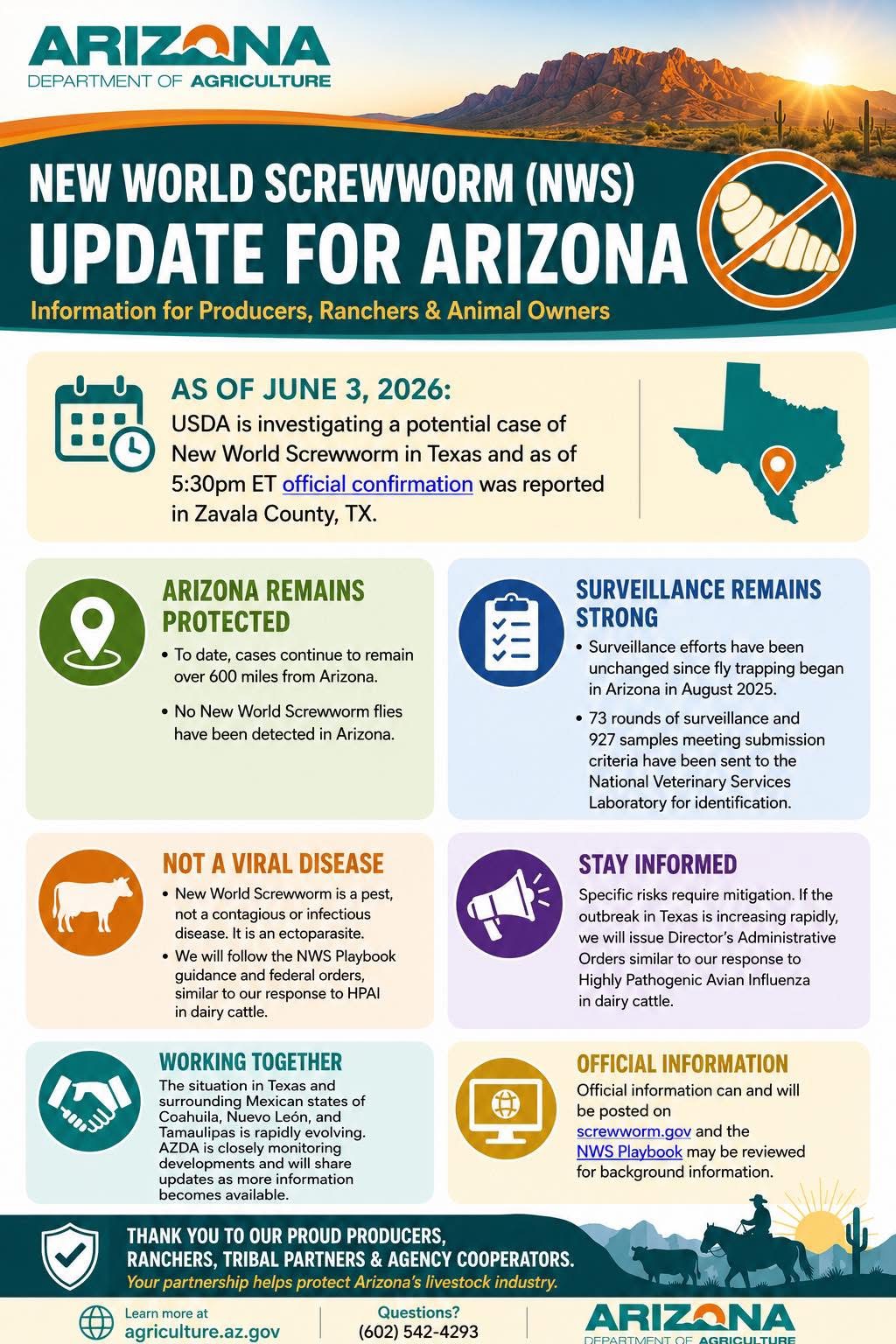
The New World screwworm (Cochliomyia hominivorax) is a parasitic fly. Unlike regular houseflies that feed on decaying matter, female screwworm flies lay their eggs in open wounds or body openings of living, warm-blooded animals and humans. If you suspect you are infected with New World screwworm, contact your doctor for an examination, and do not throw larvae in the garbage or on the ground. If one of your animals has an NWS infection, contact your veterinarian right away for an exam and treatment. Do not pull out maggots yourself.
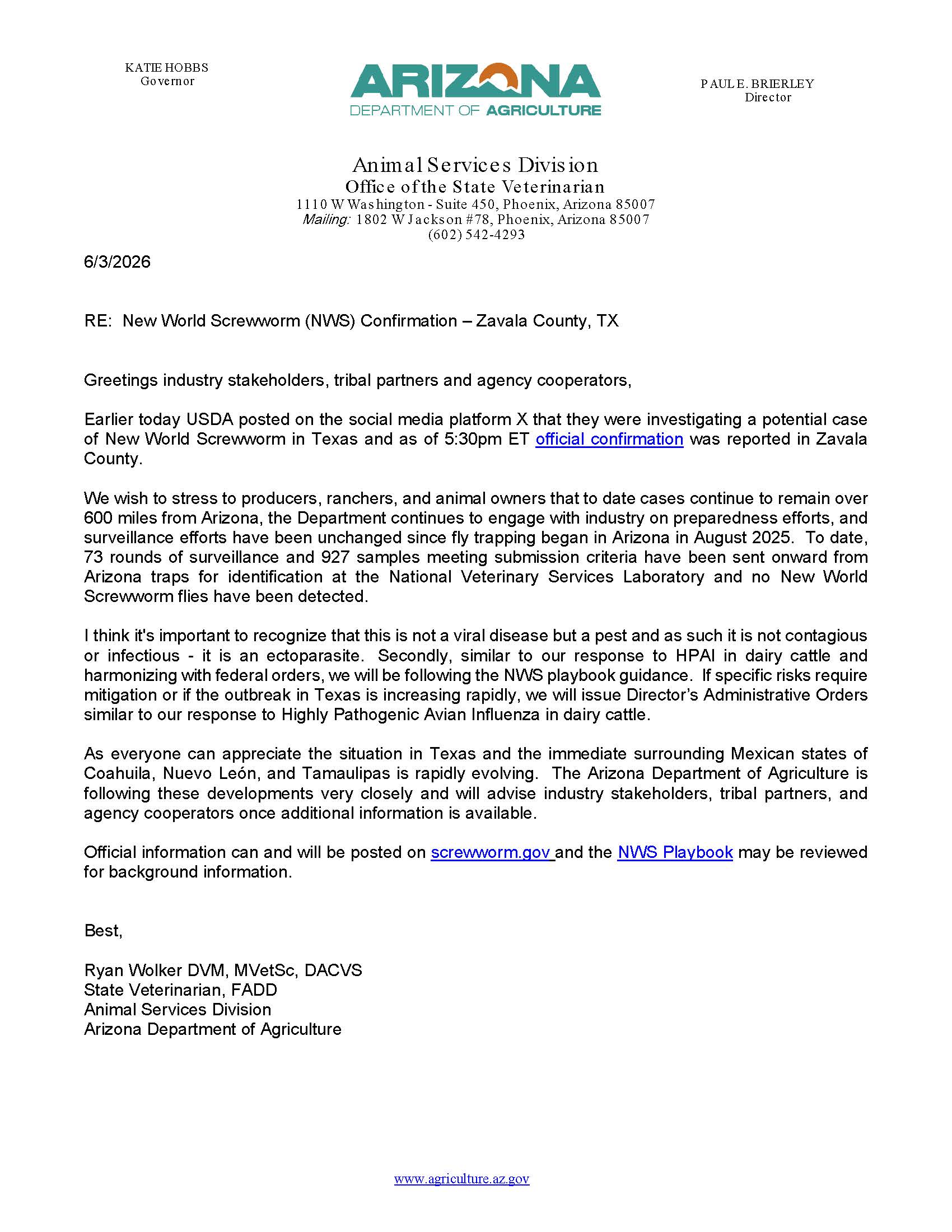
Information regarding the current NWS outbreak in the United States (US), Mexico, and Central America:
What is NWS:
NWS in the US:
- USDA Confirms Two Additional Cases of New World Screwworm in the United States
- USDA Confirms First Case of New World Screwworm in a Dog in Lea County, New Mexico, Fourth Case in Texas
- USDA Confirms Presence of New World Screwworm in the United States
- Confirmed detection of New World Screwworm in a 3 week old calf in Zavala County, Texas, near the Mexico border.
- USDA and Texas authorities established a quarantine/infested zone and activated a unified incident command.
- New World Screwworm Outbreak
- Reports >171,700 cumulative animal cases and ~2,070 human cases across Mexico and Central America since 2023.
- States no locally acquired human cases in the U.S., and overall human risk remains low.
NWS Surveillance:
NWS Emergency Preparedness:
NWS Food and Drug Administration information:
Key bills relevant to providing resources for NWS prevention in Arizona:
1. H.R. 3806 – New World Screwworm Preparedness Act of 2025
Status:
- Introduced (House Agriculture Committee)
What it does:
- Directs USDA to study and report on national strategies to prevent, detect, and respond to NWS outbreaks
- Evaluates surveillance gaps, border risks, and response readiness
- Strengthens national preparedness before outbreaks reach additional states
Why it matters for Arizona:
- Arizona would benefit from earlier detection and better federal coordination, especially given livestock movement and wildlife migration from Mexico
- Helps ensure resources and planning are in place before NWS crosses into AZ, not after
Congress.gov link:
2. S. 1751 – STOP Screwworms Act
Status:
- Introduced (Senate Agriculture Committee)
What it does:
- Requires USDA to build one or more U.S.-based sterile screwworm fly production facilities
- Authorizes $300 million for long-term eradication capacity
- Allows facilities to be located in any state at risk due to migration patterns
Why it matters for Arizona:
- Sterile fly release is the single proven method that eradicated screwworm previously
- Arizona could be:
- A downwind protection zone for sterile fly dispersal
- A logistics or dispersal corridor for western border states
- Reduces reliance on foreign facilities if outbreaks approach Sonora–Arizona routes
Congress.gov link:
3. H.R. 7466 – SAFE CATTLE Act
Status:
- Introduced (House Natural Resources & Agriculture Committees)
What it does:
- Forces USDA and DOI to coordinate on preventing and eradicating NWS
- Focuses on wildlife and non livestock species on federal lands
- Requires joint surveillance, response protocols, and reporting
Why it matters for Arizona:
- Arizona has large federal land holdings (BLM, Forest Service, National Parks)
- Wildlife (deer, elk, predators) can carry screwworm across borders silently
- This bill closes a major gap by addressing wildlife transmission—not just cattle
Congress.gov link:
